This serum clears acne in 3 days. Clinically proven results. Use my code GLOW20 for 20% off.
#ad This serum is formulated to help skin look smoother and more radiant. Individual results vary. Use my code GLOW20 for 20% off.
Paste a script or upload a video. ByeRisk flags medical, weight-loss and guarantee claims, cites the FTC, FDA or platform rule behind each one, and suggests compliant wording.
Sign up and get 100 credits to try text, video and image checks.
This serum clears acne in 3 days. Clinically proven results. Use my code GLOW20 for 20% off.
#ad This serum is formulated to help skin look smoother and more radiant. Individual results vary. Use my code GLOW20 for 20% off.
Example, not a live result · Click to switch
By the time a notice arrives, the post is live and the penalty is already in effect.
Each TikTok Shop violation deducts points from the shop's Account Health Rating. Falling below a threshold restricts campaigns and new listings, and deductions take 180 days to recover.
A creator who repeats the same type of violation can lose affiliate access and have commissions frozen, and a ban on a shop's linked creator account triggers a review of the shop.
On Amazon, saying a product resists bacteria, mold or mildew, such as an "antibacterial" mattress or a "mildew-resistant" shower curtain, is a pesticide claim. Without EPA registration or an exemption, the listing is restricted.
Ad platforms cite a policy area such as personal attributes or health claims. Finding the exact wording that triggered it is left to you.
FTC and FDA rules apply everywhere. Each platform adds its own policy layer, and each scenario has its own checks.

Short videos, LIVE scripts and product listings. Checks focus on the categories TikTok Shop names in its creator enforcement policy: medical claims, weight management and misleading promotions.

Listing titles, bullet points, descriptions and product pages: pesticide-type wording, supplement disease claims, and cosmetic wording that crosses into drug claims.

Ad copy and images: personal-attribute phrasing, before-and-after imagery, health and weight-loss claims. We check the creative only. Account status, landing pages, payment and identity verification are outside our scope.
Below are the regulations and platform policies the rule library cites, with its version and update date.
Rule library version 0.3.0 · Updated 2026-10-08
These are the sources the rule library actually cites. Every finding can be traced back to a specific clause.
Listing and content policies, weight management, supplement category access, prohibited products, and off-platform redirection
Claims must be substantiated: absolute claims, guaranteed results, safety claims, and health claims
Disclosure of paid and affiliate content, whether testimonials reflect typical results, fake or incentivized reviews, review suppression, and fake social media indicators such as bought followers
Structure/function versus disease claims for supplements, the line between cosmetics and drugs, medical claims for baby and pet products, and misuse of FDA status
Products that claim to kill germs, disinfect, sanitize, resist mold, or repel pests are regulated as pesticides: they need EPA registration and may not claim to be safe or non-toxic for people or pets
Children's products must be third-party tested and certified, and marketing may not state or imply that the CPSC approved, tested, or endorsed them
Degradable, compostable, recyclable, carbon-neutral, and "free-of" claims must be substantiated and properly qualified
Fiber content must use generic names (most "bamboo" fabric is rayon), imitation leather may not be called leather, and fur products must disclose the animal and country of origin
Lab-grown and simulated diamonds must be disclosed, since an unqualified "diamond" means a natural one; gold, silver, and platinum content and plating must be stated accurately
No false claims of approval, endorsement, or recommendation by a government agency or business, or of an affiliation with one
Earnings claims for side hustles, courses, business opportunities, and recruiting must be substantiated and disclosed as required
Product detail page rules, pesticide claims (EPA registration), misleading and prohibited claims, and restricted categories such as supplements and cosmetics
Personal attributes, health and body image, drugs, and special ad categories
Editorial requirements, clickbait and unreliable claims, healthcare and unapproved substances
Weight management and body image, misleading content, ad format, healthcare, and housing, employment, and credit ads
The rule library is updated with TikTok Shop US policies and current US regulations. Below is the current coverage for each content type.
A check covers the content you submit. These issues sit outside it, and we say so up front.
Shop health, account status, identity verification and appeals are decided by the platform and are not part of a content check.
We check the text and images you submit, not the pages they link to.
We check LIVE scripts. Anything said off-script during a stream is not covered.
Whether a product or category may be sold is decided by the platform's approval process. A clean check does not grant it.
What happens to the scripts, videos and images you submit, stated plainly.
Traffic is encrypted with HTTPS / TLS, access is role-based, administrative actions are logged, and development and production are kept separate.
Content is stored while your account is active so you can review past checks. You can delete any record yourself, effective immediately.
Content you submit is processed and stored on ByeRisk servers in mainland China.
Each finding cites the regulation or platform policy behind it, so you can check the source yourself.
From the rule behind each flag to wording you can publish.
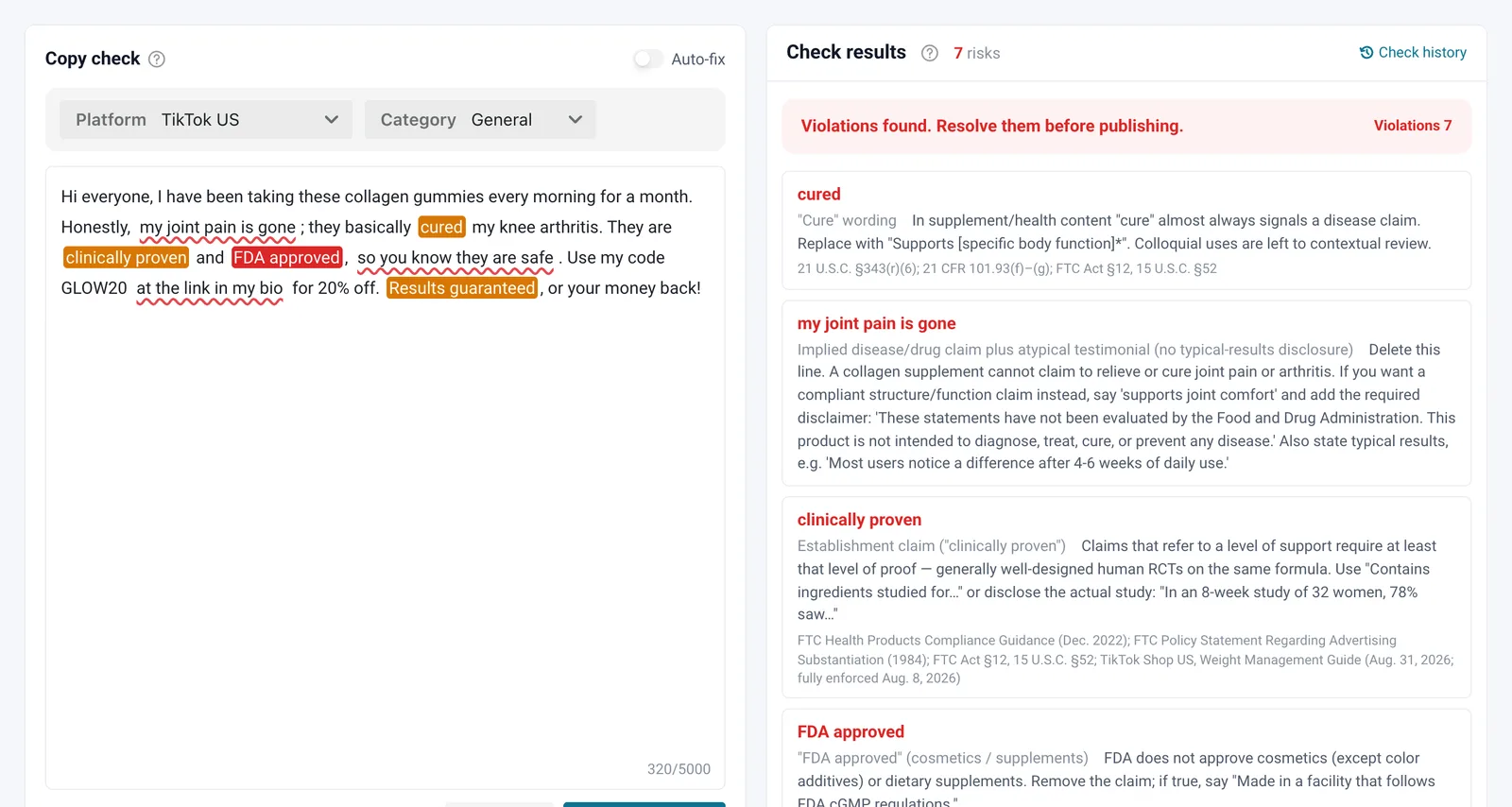
Paste a caption, script or listing. Each flagged phrase is highlighted in place, with the regulation or platform policy behind it and wording you can publish instead.

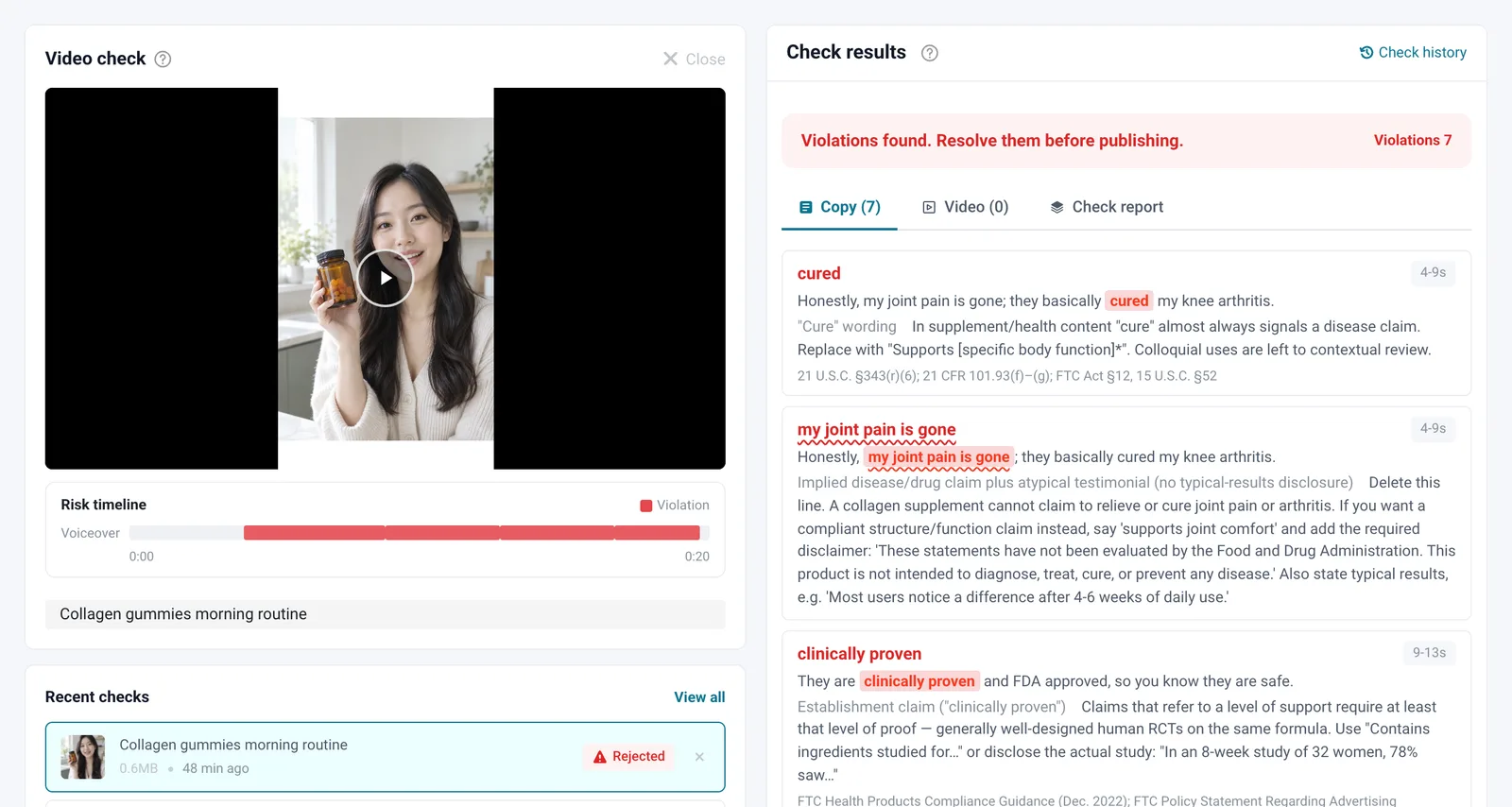
Upload the finished video. Speech is transcribed and checked sentence by sentence, alongside on-screen text and frames, and each finding is pinned to its timestamp.

Each finding cites the FTC guide, FDA regulation or platform policy it is based on, so you can verify it yourself.
Speech is transcribed and checked with the same rules as text, alongside on-screen text and frames. Each finding is timestamped.
LIVE scripts are checked as text before the stream, where claims are easiest to fix.
Categories range from beauty, health and supplements to baby, apparel, jewelry, home and pet. Wording that is only a problem in certain categories, such as disease claims for supplements, is checked against the category you choose, which reduces false flags.
Flagged wording is rewritten to describe what the product does without disease, cure or guarantee claims, then checked again.
Sellers, creators and brands need the same standard, and a record of why.

Titles, bullet points and scripts are written quickly, and no one checks the claims before they go live.
Run a check before publishing and fix flagged wording with the suggested rewrite.

Repeating the same type of violation can cost affiliate access and freeze commissions.
Check the script before filming and the finished video before posting; findings are pinned to the second.

Creator videos, listings and ads go out under one brand, each under a different platform policy.
Review creator scripts, listings and ad creative against one rule library, with a cited source kept for every finding.
All check types are available on every plan; plans differ in credit allowance and additional benefits. Plans and credit packs are one-time purchases through Stripe, with no automatic renewal.
Loading
These terms make every check result easier to read.
A disease claim states or implies that a product diagnoses, treats, cures, mitigates or prevents a disease. Under FDA rules, disease claims are reserved for drugs; a cosmetic or dietary supplement that makes one can be treated as an unapproved drug.
FD&C Act · 21 CFR 101.93A structure/function claim describes how a dietary supplement affects the normal structure or function of the body, such as "supports joint comfort". It must be truthful and substantiated, and the label must carry the FDA disclaimer that the statement has not been evaluated.
DSHEA · 21 CFR 101.93Substantiation is the evidence behind an objective claim. The FTC requires advertisers to have a reasonable basis before a claim is made, and health claims generally require competent and reliable scientific evidence.
FTC Act §5 · §12A material connection is a relationship between an endorser and a brand that could affect how the audience weighs the endorsement, such as payment, free products or affiliate commission. It must be disclosed clearly and where viewers will not miss it, for example with #ad in the post itself.
16 CFR 255Account Health Rating is the score TikTok Shop US uses to track a seller's policy compliance. It starts at 200 on a scale of 0 to 1,000. Violations deduct points, falling below set thresholds restricts the shop, and each deduction takes 180 days to recover, so the most effective fix is the one made before publishing.
TikTok Shop Seller UniversityA pesticide claim says a product prevents, destroys, repels or mitigates pests, which include bacteria, mold and insects, for example a mattress described as "antibacterial" or a "mildew-resistant" shower curtain. Such a product is treated as a pesticide that needs EPA registration unless an exemption applies, and Amazon restricts listings that make the claim without it.
FIFRA §2(u) · 40 CFR 152.15Coverage, rule sources, limits, data handling and pricing.
No. A check lowers risk by catching problems before you publish, but the platform makes the final decision. What we guarantee is that every finding cites a rule you can verify.
The rule library is built on 15 sets of regulations and platform policies: FTC rules on claim substantiation, endorsements and reviews, environmental and earnings claims, false claims of government or business endorsement, and textile and jewelry labeling; FDA rules on supplement, cosmetic and baby product claims; EPA pesticide registration rules; CPSC requirements for children's products; and the policies of TikTok Shop US, Amazon and the Meta, Google and TikTok ad platforms. The full list, with the rule pack version and update date, is in the "What we check against" section of this page.
Yes, for TikTok. Speech is transcribed and each sentence is checked with the same rules as text; on-screen text and frames are reviewed as well. Findings are timestamped, so you re-record only the part that needs it.
We check LIVE scripts. Anything said off-script during the stream is not covered, and that is where claims most often go too far.
Yes. Listing titles, bullet points and descriptions for Amazon and your own store are checked as text. Ad copy and images for Meta, Google and TikTok Ads are checked against each platform's policy. FTC and FDA rules apply on every platform, and each platform adds its own policy layer on top. Video checks are available for TikTok.
No. We can show which wording is likely to have triggered a content violation and help you fix it before you resubmit. Account, identity and landing-page issues are outside our scope, and we cannot restore disabled accounts.
No. ByeRisk is a screening tool, and a check result is not legal advice. For regulated products, consult qualified counsel.
Not yet. Image checks cover visual risk and prohibited products. Reading claims written on images is the next stage, so it is not listed as covered. For an image that carries a claim, submit its wording through a text check.
Checks and AI rewrites use credits, and new accounts get 100 credits to try every check type. Plans and credit packs are one-time purchases through Stripe, with no automatic renewal. Current prices are listed in the Pricing section of this page.
Content is stored while your account is active so you can review past checks, and you can delete any record yourself at any time, effective immediately.
Create a free account and try text, video and image checks with your sign-up credits.
100 credits on sign-up · No payment method required